The Elliott Wave Theory helps to identify the current trend direction, where price is in the current trend and provides high confidence price targets. Let’s take a look at each of these and how to apply them to trading. Before all that, let’s first look at an overview of the Elliott Wave Theory.
What is the Elliott Wave Theory?
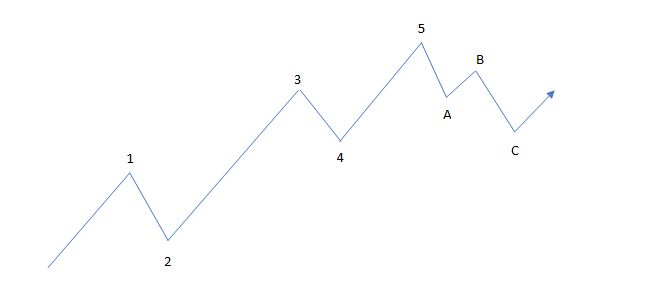
The Elliott Wave Theory states that price moves in motive and corrective waves. Motive waves have a five wave structure. Corrective waves have a three wave structure as shown above.
This pattern occurs over and over again, in all time frames or wave degrees. The trick to using the Elliott Wave Theory is being able to identify the current wave as it is developing in the time frame you want to trade and how that relates to higher wave degrees.
Typically, the length of the waves is related by Fibonacci numbers. Many times, wave 2 will retrace 61.8% of wave 1. This makes a possible entry point for a long position, like in the example above. Another possible trade opportunity is at wave 4, which typically retraces 38.2% of wave 3.
Determining Current Trend
If we have seen the price retrace 61.8% from the recent high and then turn up, we can assume we are at the beginning of wave 3 and that price has a good chance of increasing, in the example above.
Likewise, if price has moved up significantly such that the distance is 1.618 times the length of wave 1, we might be at the end of wave 3. A trader may want to wait for a pullback in wave 4 before going long for wave 5.
Elliott Wave Price Targets
The Elliott Wave Theory also gives us possible price targets for each wave. The length of wave 3 is usually at least 1.618 times the length of wave 1. Often, there will be an opening gap in wave 3. This helps to identify wave 3 in higher degrees. Wave 5 is typically the length of wave 1. Those are the estimates I’d start with when identifying a trading opportunity. As the wave develops these may change and oftentimes do. For a complete discussion of the Elliott Wave Theory, I recommend reading the Elliott Wave Principle by Frost and Prechter.
Of course, the market rarely gives us such a clear wave structure as shown above. However, it is still possible to identify good trading opportunities.